 Skip to content


What if you had an assistant at your disposal who, instead of constantly “putting out fires” with disapproved products in Google Merchant Center (GMC), proactively suggested solutions before your Performance Max campaign revenues started to drop?
For e-shop owners and marketing agencies, managing product feeds is often an endless battle with technical errors, unclear policies, and constant changes in the Google interface. Every disapproved product or incorrectly matched attribute means wasted budget and lost profit.
However, according to recent findings, the tech giant is quietly testing a tool that could fundamentally change this process. Merchant Advisor—a dedicated AI assistant ready to provide real-time advice directly within the account—is coming to the Merchant Center interface.
What exactly does this innovation mean for the e-commerce ecosystem, how does it work, and why should agencies pay close attention?
What is Merchant Advisor and where did it come from?
This is an implementation of generative artificial intelligence directly into the GMC (Google Merchant Center) user interface. If you have already had the chance to see the Google Ads Advisor feature, the principle will feel familiar. Essentially, it is an advanced, ever-present AI guide (a so-called “agentic experience”) capable of analyzing your e-shop’s data and answering specific questions regarding settings, optimization, and feed errors.
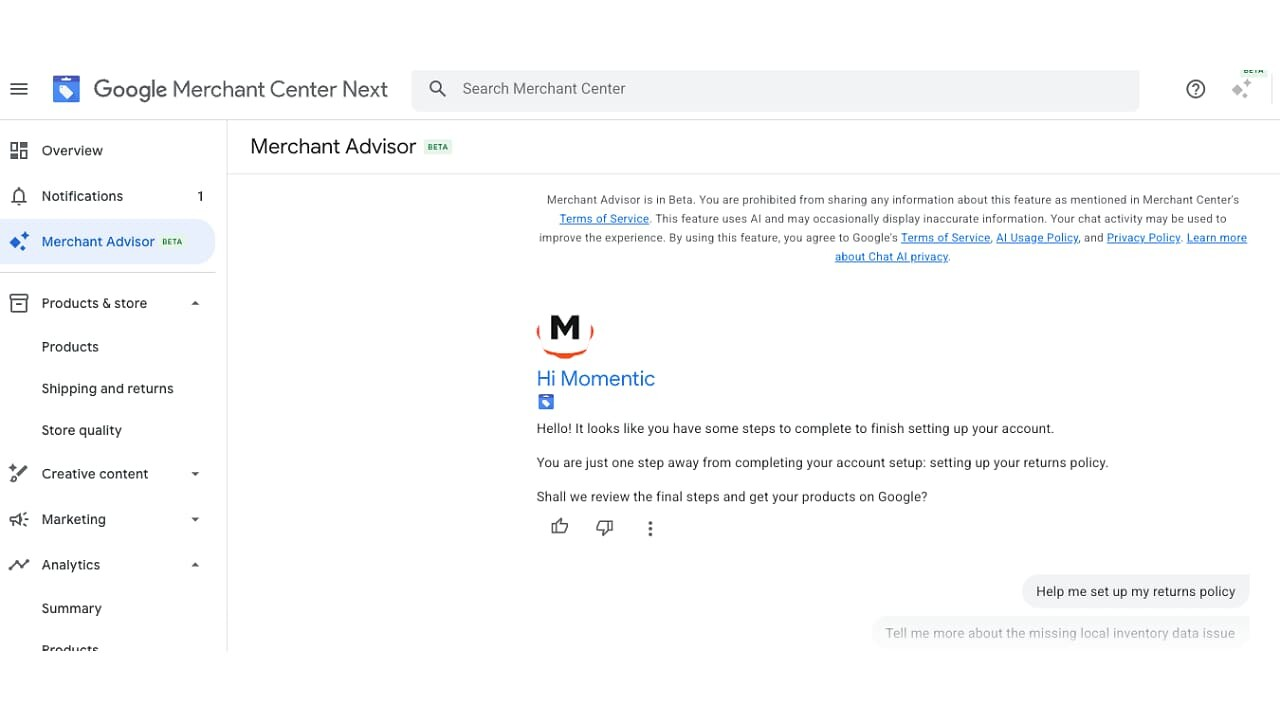
Source: PPC News Feed
From troubleshooting to growth marketing
Merchant Advisor is not just a basic search engine for Google Help Center. According to statements from Google representatives on the Ads Decoded podcast, the goal is to build a “proactive partner for e-commerce growth.” The tool is expected to assist primarily on two levels:
A. Technical Management and Troubleshooting (Removing Barriers)
For an e-shop owner, seeing a red “Account suspended” notification or mass product disapprovals due to missing GTINs or price mismatches between the feed and the website is a total nightmare. Instead of skimming through endless pages of technical documentation, you will be able to ask the assistant directly: “Why did Google disapprove my summer dresses category, and what is the fastest way to fix it?” The AI will instantly link diagnostic data with actionable troubleshooting steps.
B. Strategic Optimization (Growth Marketing)
Since product data is currently a foundational pillar for Google—not only for standard Shopping ads but also for integrations with Connected TV (CTV) and YouTube – its quality determines campaign success. Merchant Advisor can evaluate the robustness of your feed and alert you to opportunities:
- Missing key attributes (e.g., color, material, size) that would increase search visibility
- Price adjustment recommendations based on competitive market trends.
- Identification of high-potential products that are currently receiving low impression trajectories.
Why is this a crucial milestone?
This step aligns perfectly with Google’s broader strategy for 2026. Recently, a specialized hub called Merchant Center for Agencies was launched globally, as reported in more detail by Search Engine Roundtable. Google is trying to centralize the management of multiple client accounts under a single interface, reduce administrative friction, and use AI to put massive market intelligence into the hands of marketers.
What it means for e-shop owners (In-house teams):
Small and medium-sized e-shops often lack the budget for dedicated feed managers. For them, Merchant Advisor will act as a free consultant, helping them navigate the complicated approval process without having to pay expensive external specialists for basic technical tasks.
What it means for agencies:
Agencies are not losing their jobs, but their role is shifting. If a significant portion of their billable hours has previously consisted of manually cleaning up feed errors, this commodity work will quickly become automated thanks to AI.
Agencies will need to shift from mechanical “clicking” to business strategy. While Merchant Advisor will generate an overview of opportunities, creative budget management, client margin analysis, and omnichannel marketing orchestration remain human responsibilities.
Conclusion
The official unveiling and gradual rollout of the feature to the wider public is expected in the near future, likely during upcoming key Google conferences.
For e-shop owners and agencies, this leaves only one task: stop viewing Google Merchant Center merely as a passive product repository. Get ready for it to become an intelligent ecosystem. Those who learn to cooperate with AI assistants first will gain a massive competitive advantage in targeting accuracy and ad spend efficiency.