 Skip to content


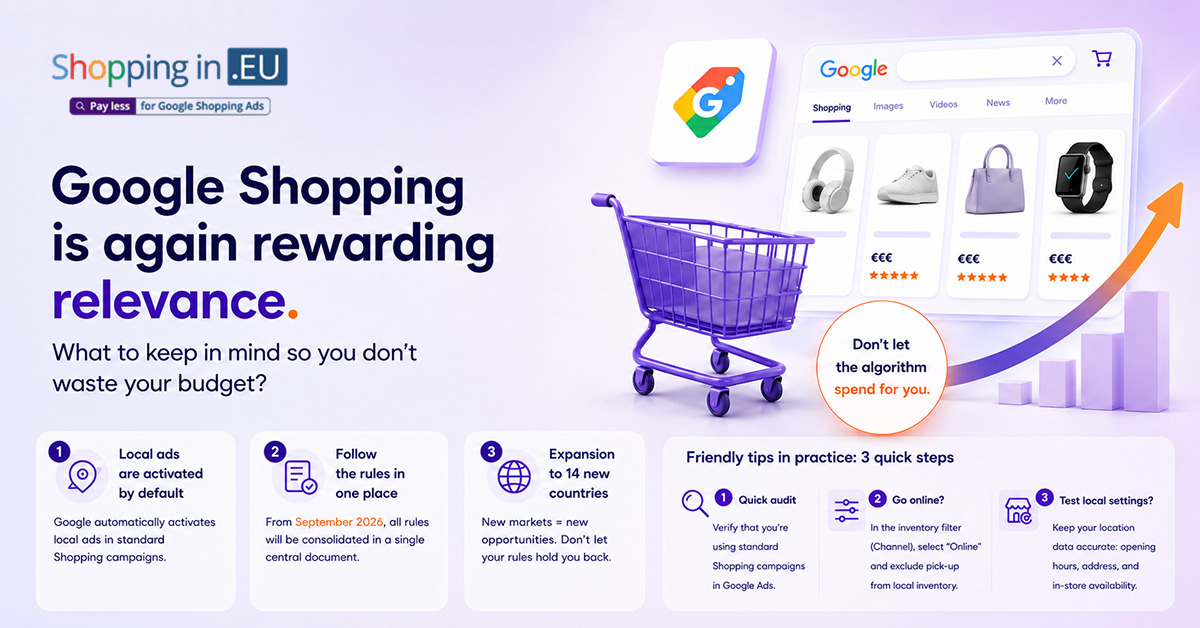
Google isn’t slacking off this summer and is preparing changes to Shopping that could really shuffle the deck.
By the way, just a minor side note-have you noticed that Google Merchant Center Next is back to being just Google Merchant Center? That grandiose word “Next” quietly disappeared, and Google went back to the old classic.
But back to the important stuff. Things are happening in the system that you shouldn’t overlook; otherwise, the algorithm might unpleasantly surprise you. Here is the main stuff that’s changing and how to prepare for it.
1. Local Inventory Ads Will Turn on by Themselves
If you have a brick-and-mortar store in addition to your e-shop, this one is for you.
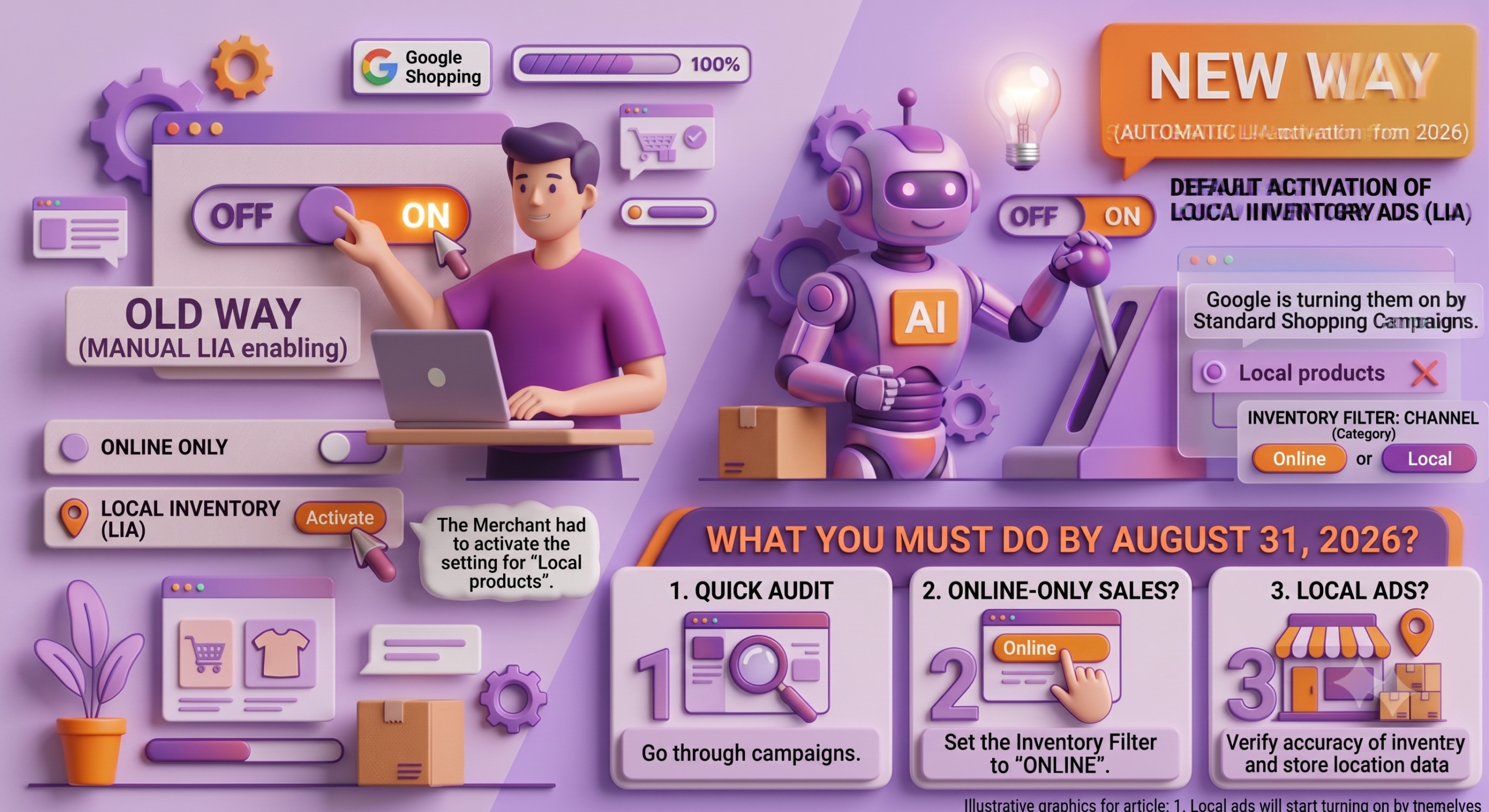
Until now, if you wanted to show local people that they could come pick up goods right at your store, you had to explicitly activate these Local Inventory Ads in your campaigns.
But Google is tweaking this now and is starting to turn it on automatically in Standard Shopping campaigns.
If you want to sell exclusively online and not lure people into a physical store, you need to hurry up. You only have until August 31, 2026.
By this date, you must set the inventory filter right in the campaign to show you only sell “online.” Otherwise, it will launch on its own, and your budget will start being spent where you don’t want it to.
Friendly Practical Tips: What Exactly Should You Do Now?
Don’t panic, you can tidy up your account in three clicks. Here is a quick cheat sheet (inspired by recommendations from PinMeTo) on how to proceed:
1.Quick audit: Open Google Ads and filter out your Standard Shopping campaigns.
2.Only want online sales? Pull the brake: In the campaign settings, find the inventory filter (Channel) and strictly select the “Online” option. This will forbid Google from pumping money into local impressions.
3.Want to test local ads? Clean up your data: If you leave it on, you must have 100% accurate opening hours, addresses, and especially in-store stock levels. A customer who drives across town for sold-out goods will never shop with you again.
2. Rules Under One Roof. Will It Help?
Do you like poring over Google’s terms and conditions? Probably not…
Until now, we had two different documents for paid ads and free listings. Starting in September 2026, Google is putting an end to this and merging them into one central Shopping policy.
The official version is that it’s not a tightening of rules; it will just clearly mark in the same text what applies to ads and what applies to free listings.
It sounds quite reasonable, but among marketers, there’s a rather amused skepticism. As Barry Schwartz from Search Engine Roundtable summarized based on advertiser reactions: “What does this mean for you in practice? Absolutely nothing, the whole thing will be just as unclear as before.”
So, the rules will be in one place, but why a certain product got rejected will likely remain a mystery from time to time.
3. Expansion Into 14 New Countries and Its Pitfalls
Are you planning to expand your business across borders? As we mentioned in our last article, Google Shopping officially expanded into 14 new countries in July, including Croatia, Bulgaria, the Baltics, and Serbia.
It’s a perfect chance to grab a piece of the market before the competition wakes up. However, there is a major catch.
Google is extremely strict about local laws. While you might get away with something without problems in one market, your account will get blocked instantly in another. Watch out especially for these:
🍺 Alcohol: In Croatia or the Baltics (Lithuania, Latvia, Estonia), you simply can’t run ads for beer or wine.
💊 Medication: In all 14 new countries, there is a total taboo on promoting any medications, even common over-the-counter ones.
🔞 Adult Content: If you sell adult products, you won’t be able to target a campaign to Serbia through Shopping at all.
So, What Now?
The conclusion is quite simple… don’t let your campaigns live a life of their own.
Open Merchant Center, click through the local ads settings by the end of August, and if it makes sense for you, explore new markets. It’s better to spend ten minutes checking your settings today than to wonder about a burned-through budget in September.