 Skip to content


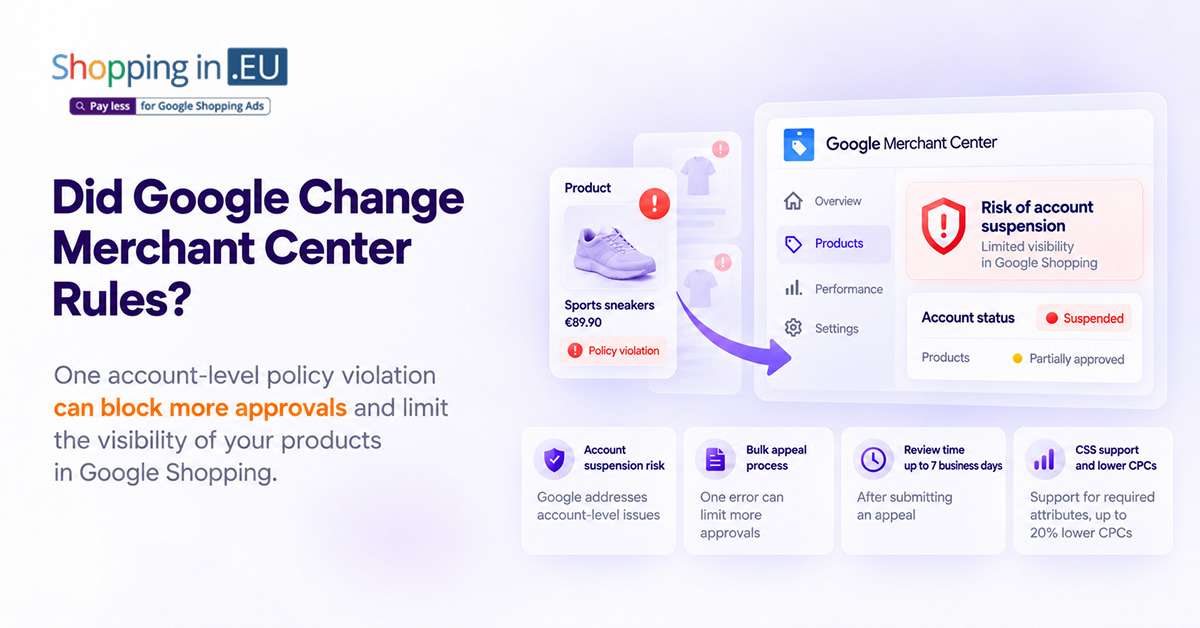
Most e-shops only address Merchant Center policies when a disapproval occurs: they fix the product, click appeal, and wait. However, Google has recently updated several key documents, shifting the focus from individual products to the entire account. Notably, Google suspended 24.9 million advertising accounts in 2025 alone.
If you think a “minor disapproval” affects you only marginally, this article could save you weeks of frustration.
What Has Google Actually Changed in Merchant Center?
What is important is what has not changed. The definitions of prohibited products remain the same. What has changed is the enforcement and appeal procedure upon violation.
1. Focus on Account-Level Enforcement
The new documents place greater emphasis on account-wide issues that restrict product visibility. For severe violations, such as counterfeit or dangerous products, the impact threatens the entire account, not just the problematic items.
2. New Bulk Appeal Option
A new option to submit a bulk appeal for a large set of offers has been introduced. Google attached a strict warning to this feature: before submitting, you must review the offers and remove any violating ones. If violations are found during a bulk appeal, the request may fail immediately and limit your ability to submit further appeals.
3. Unified Path in the Interface
All documents now point to the same path: Products & store → Needs attention → View fix, with two variants (across all products or via product details).
4. Instructions for Third-Party Platforms
If you manage your feed via a platform (e.g., Shopify), you should look for appeal options directly within its interface.
Aha moment: Google gave you a tool for bulk appeals, but if you use it without auditing your feed first, a single mistake can restrict your future attempts.
Why This Is Crucial for E-Commerce Stores
An appeal is not processed instantly. According to Google, an account review typically takes 7 business days, and longer for complex cases. Accounts are restored only for compelling reasons, which is why Google demands thoroughness, accuracy, and honesty.
An unsuccessful review may also be followed by a cool-off period before you can submit another request.
Furthermore, mistakes happen even to legitimate stores. Google claims to have reduced incorrect suspensions by 80% thanks to Gemini. At the same time, some advertisers have reported bulk ad disapprovals without any actual violation.
What to Do Before Submitting an Appeal
- Audit your feed. Review categories and attributes sensitive to policies (dangerous, counterfeit, sexually explicit products, misleading claims).
- Remove violating offers before submitting a bulk appeal.
- Document changes: what, when, and why you modified.
- Do not send repeated requests “just to be safe”-you risk triggering a cool-off period.
- Monitor your account continuously, not just after a disapproval occurs.
Where Manual Review Ends
Managing a feed manually is manageable with 50 products. However, with hundreds or thousands of SKUs, you quickly lose track, and that is where a minor detail becomes a risk for the entire account.
When dealing with account issues, it helps to have someone you can turn to for assistance. For e-shops in the EU, this can be a CSS partner (Comparison Shopping Service). You are not required to use one, but it often pays off. An independent CSS partner does not charge the margin that Google deducts on its own CSS – which is approximately 20% of your bid prior to the auction.
The market is vast: by the end of 2024, over 1,000 CSS partners were registered, serving 600,000+ merchants. Therefore, it is worth considering what kind of support a partner can offer when you encounter an issue.
How We Help at CSS Shopping in EU
You don’t have to take our word for it, but let’s be upfront about how it works. At CSS Shopping in EU, we do not interfere with your account or your feed, nor will we meddle in your setup. However, if you run into a problem – such as product disapprovals or account restrictions – you can simply reach out to us and we will help you resolve it.
No CSS partner can guarantee that you will avoid suspensions altogether. The difference is that when a problem arises, you won’t be left on your own. Behind us is a PPC team with over 11 years of experience with Google Ads.
- Support when you need it: contact us when you face an issue, and we will assist you.
Lower CPC: as a CSS Premium Partner, we help you reduce your Shopping ad costs by approximately 20%.
- Coverage across all 21 EU countries and the option to try our service for 30 days free of charge.
Conclusion
Google hasn’t changed what is prohibited, but it has significantly tightened what happens when something goes wrong. The unit of risk is now the entire account; therefore, it pays off to safeguard your feed before the first disapproval arrives and to have expert support readily available.
FAQ: Frequently Asked Questions
No. According to an analysis by Search Engine Roundtable, definitions (e.g., counterfeit or dangerous products) remain the same. The main change concerns the violation and appeal procedures.
It is a mass appeal submitted for a large batch of offers. Use it only after removing all violating items, as an unsuccessful appeal can restrict future attempts.
According to Google, it typically takes 7 business days, though complex cases may take longer.
No, it is not mandatory. However, an independent CSS partner can reduce your CPC by approximately 20% and provide support when account issues arise.