 Skip to content


In the online space, where millions of products are available, customers make decisions within seconds. And very often based on one thing – which reflects how your product feed looks.
The feed is not just a data file about products. It’s your shop window, your store, your brand, and your salesperson all in one. And yet, many e-shops still see it only as a technical file that simply “has to be there.” But “being there” is no longer enough. In Google Shopping, it’s a game of positions, clicks, and sales… and in this game, the quality of your feed is what makes the difference.
Google Shopping is not just about who pays more…
Yes, it works on an auction principle. But not only based on price. Google evaluates how well your feed matches what the customer is looking for. And if your feed is weak, even a high bid might not save you. An optimized feed reduces CPC, increases conversions, and improves ROAS – and those are exactly the parameters we want to achieve.
Optimization is not “optional.” It’s fundamental.
The difference between a “correct” and a “high-performing” feed
A technically correct feed passes the check in Google Merchant Center (GMC). But that doesn’t mean it sells.
Correct feed: all required fields are filled, the product is visible
High-performing feed: the title matches the customer’s intent, the description answers their questions, attributes are complete, the category is accurate, the image is attractive; the result is a higher click-through rate and more sales
Titles as the most important text marketers (don’t) write
In Google Shopping, a title is not just a title. It’s the main anchor point for both the algorithm and the customer. And this is where most e-shops make their biggest mistake.
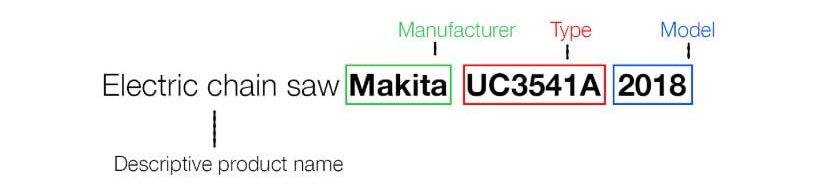
Let’s compare:
Elegant jacket
- Women’s winter jacket Columbia Powder Lite – black, size M
Which one works better? Of course, the second version. Why? Because it contains what the customer is looking for: gender, season, brand, model, color, size. And it’s all presented clearly and naturally. That’s the foundation of a high-performing feed.
Source: BlueWinston
Attributes that sell (or don’t exist)
Attributes like brand, size, color, material, GTIN, MPN, or gender are not only recommended, they are essential for precise ad targeting. Google needs to know what you’re selling. And if you don’t tell it clearly, it will show your product less often or – worse – completely wrong.
It gets even worse if this data is missing in other languages or regions. The feed must be localized, not just translated.
Don’t underestimate categorization
While Google can assign a product category automatically, that doesn’t mean it will do it correctly.
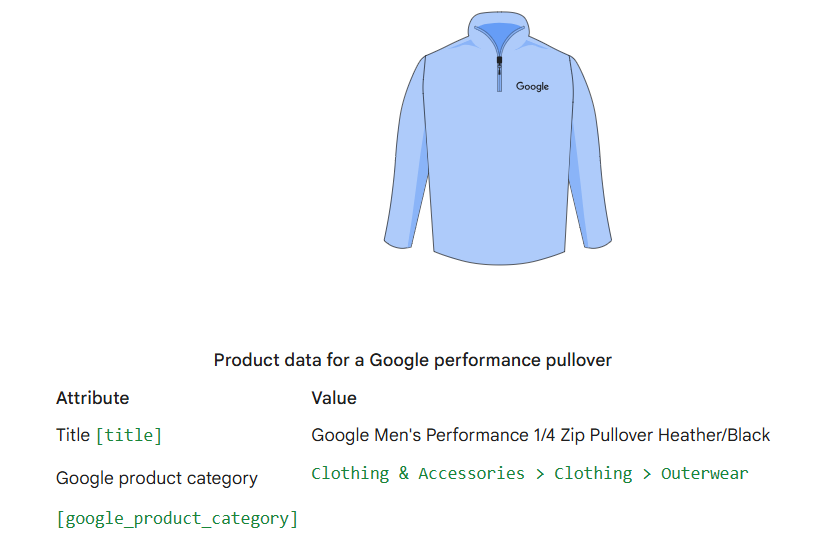
Google Product Category (GPC) – standard category from Google’s taxonomy
Product Type – your own categorization, which helps the system better understand the context
The point is, the deeper the categorization, the better the targeting:
E.g.: “Clothing > Men’s Clothing > Hoodies > With Hood > With Zipper” is far more effective than just “Clothing”
Source: Google product category
Images
A bad image can “kill” even the best product. That’s why Google prefers:
clean, high-quality photos (ideally 1500 × 1500 px)
- product with no distracting background
- multiple angles (additional images)
- for fashion: virtual try-on if the image format allows it
Last chance: Description
The product description may not appear directly in the ad, but it’s crucial for long-tail searches and on-site conversion.
Instead of listing features, write benefits:
- Material: 100% cotton, size M, V-neck
- This T-shirt made of soft 100% cotton is perfect for everyday wear. The V-neck and comfortable fit ensure you’ll feel great all day long.
Why the CSS partner loves (and needs) your feed
A CSS partner is not just a discount on click-throughs. If you want to use it to its full potential, it must have access to a quality feed. That’s what allows it to create product selections based on margin, stock, or seasonality, test new formats like Performance Max, and scale performance without wasting budget. Better feed = better performance.
Conclusion
Your product feed is not a technical detail. It’s your sales strategy.
Google Shopping does not forgive mediocrity. If you want your e-shop to grow, it’s not enough to just “list products” – you have to actively work on them. An optimized feed is currently one of the most effective investments into your e-shop’s performance. And you’ll achieve even better results if you combine this optimization with the possibilities a CSS partner offers.
Do you feel like your feed could perform better?
Our team at Shopping in EU is among Google’s premium CSS partners, so don’t hesitate to contact us with any questions about cooperation or advertising. We’re happy to offer you a free consultation with our PPC specialists, who are ready to help.
And the best part – you can try all the benefits of working with CSS partners firsthand. We offer a 30-day trial period with no commitment.