 Skip to content



Automotive is moving to the next level.
Automotive sales are changing. Fewer cars in stock, more configurators. Today, customers often don’t visit a showroom to pick a car standing in the parking lot. Instead, they click through it online – choosing the color, trim, engine, and accessories – and the car is only manufactured based on that specific configuration.
This model has been used for years by brands like Tesla, Rivian, or Lucid Motors. Now, traditional dealers are gradually adopting it as well.
The problem was that Google’s advertising ecosystem wasn’t fully prepared for this type of sale. Google Merchant Center simply lacked the correct way to label such a product.
When a car is neither in stock nor unavailable
Until now, sellers in Merchant Center only had a few basic availability statuses:
- in_stock
- out_of_stock
- preorder
- backorder
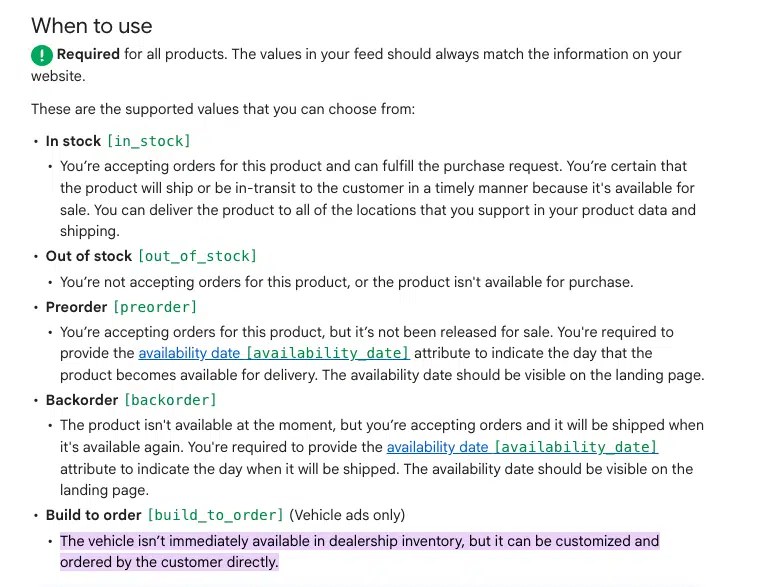
Source: Search Engine Land
However, none of these accurately captured the situation where a customer configures a car and orders it directly from the factory.
This led to classic feed paradoxes:
- A car marked as in stock, even though it doesn’t physically exist.
- Out of stock, which caused the ad not to show at all.
The result? Sometimes disapproved listings, other times poor campaign performance. Simply put: data chaos between the feed, the vehicle landing page, and what Google displayed to users.
The Solution: The new build_to_order attribute
Google has therefore added a new availability status:
- build_to_order
It is used for vehicles that:
- are not physically in stock
- can be configured by the customer
and the vehicle is manufactured or ordered only afterward
This is exactly the scenario we know from today’s online configurators.
This model typically appears in two situations:
- Direct-to-consumer sales – the brand allows the customer to select the model and configuration and order the vehicle directly online.
- Factory orders at dealerships – the dealer accepts an order for a specific configuration, and the vehicle is subsequently manufactured.
Technical implementation (the “must-haves”)
For Google to correctly understand vehicle availability, two things must be aligned:
1. Merchant Center feed
build_to_order
2. Structured data on the vehicle page
“availability”: “https://schema.org/BuildToOrder”
If these two data sources are inconsistent, the system may automatically disapprove the listing.
One rule to watch out for
For build-to-order vehicles, the condition must always be:
- condition = new
The logic is simple: the car does not exist yet; it is manufactured only after the order. Therefore, it cannot be marked as used.
If Merchant Center finds the combination:
- availability = build_to_order
- condition = used
it will automatically mark the product as invalid for this type of offer.
Why this actually matters
At first glance, this is a small technical detail in the feed. In reality, it is a response to a much larger trend.
Automotive sales are gradually shifting from stock inventory to custom orders.
Product feeds no longer represent just current inventory. They represent the entire sales potential of a brand-including cars that have yet to be built.
Conclusion
If you have vehicles that customers configure or order from the factory, correctly setting up build_to_order will help you:
- Communicate vehicle availability more accurately
- Reduce the risk of disapproved listings
- Improve the quality of traffic from Google campaigns
Because today, a large part of the purchasing decision starts in Search. And when the data is accurate, advertising works significantly better.