 Skip to content



Every e-shop owner knows this: you open Google Ads, look at the numbers… and somewhere deep down you’re not entirely sure whether those results are real, or whether Google is “polishing” them according to its own rules. Until now, you had good reason to doubt.
Inflated conversion values
For years, Google Ads has been working with various conversion value adjustments, from value rules (e.g. +30% value for mobile users), through lifecycle goal adjustments (bonuses for new customers), to internal adjustments used by Smart Bidding.
These adjustments help the algorithm, but for anyone who wants to see real revenue, they created chaos. The numbers in Google Ads often didn’t match reality in the e-shop, analytics, or accounting. ROAS looked artificially higher, and when performance dropped, you couldn’t tell whether customer behavior had changed or Google had simply adjusted its calculations. In short, transparency was missing.
The new “Original Conversion Value” metric
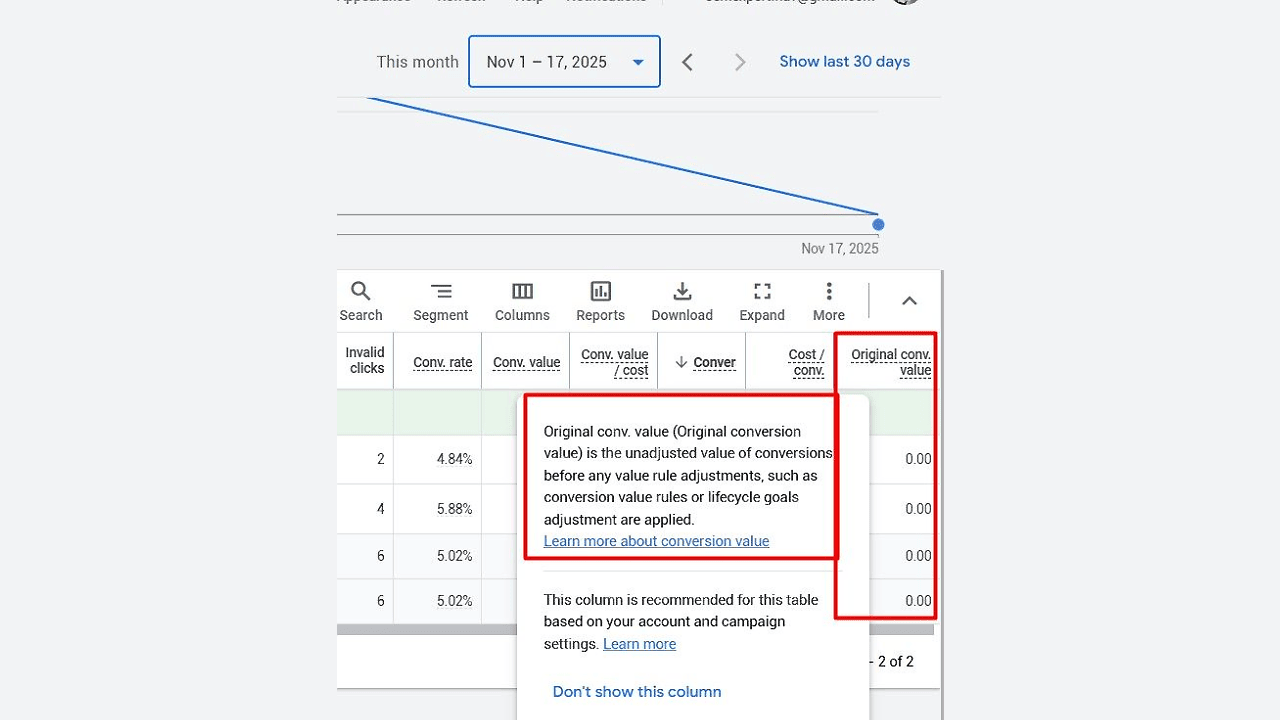
In November 2025, a new metric started appearing in accounts: Original Conversion Value.
It represents the true, unadjusted conversion value – “raw” data without value rules, without new-customer bonuses – simply what the e-shop actually earned. Google removes all its adjustments and shows the clean value.
Source: PPC News Feed
How does it work?
Google breaks down the conversion value into individual parts:
Conversion Value
- adjustments according to value rules
- adjustments according to lifecycle goals
Original Conversion Value
For the first time, you can clearly see where the differences in the data come from.
For e-shops and PPC specialists, this means a significant simplification of work:
- a more realistic view of campaign performance
- easier identification of problems and causes of performance drops
- more trustworthy ROAS without inflated numbers
- simpler reports for management or clients
Original Conversion Value therefore shows the raw, unadjusted conversion value before the system interferes in any way.
This metric will very likely become the standard for evaluating revenue, campaign audits, performance diagnostics, and comparisons between periods and campaigns. It’s a small feature with a big impact: for the first time, we have a completely clean view of what campaigns actually deliver.
What does this mean in practice?
If you want to get the most out of the new metric, it’s worth adjusting your internal processes as well. Check whether your revenue tracking is set up correctly, whether you’re sending accurate values to Google Ads, and whether you can distinguish orders by individual traffic sources.
At the same time, we recommend including Original Conversion Value directly in your dashboards and regular reports, so you can quickly see the difference between what Google reports and what the e-shop actually earns. This gives you a stronger foundation for decision-making and a clearer picture of which campaigns truly drive the business forward.
Conclusion
Until now, Google adjusted values according to its own needs. Now, for the first time, it shows numbers without filters, bonuses, or algorithmic interventions. And you can finally see how much money your campaigns are really generating. For e-shops that want to grow based on data, not estimates, this is a major step toward transparency.