 Skip to content


Your video ads may soon start talking. And you might not even know about it.
A new feature has begun appearing in Google Ads accounts that automatically adds AI voice-overs to video ads in Performance Max campaigns. If a video doesn’t contain spoken narration, the system can take text from the ad and turn it into a realistic-sounding voice.
For many advertisers, this could mean better video performance without additional production costs. At the same time, it represents a change that could influence how brands communicate in their ads.
How AI voice-over works in P.Max
The new feature is part of a broader set of video enhancements that Google has been gradually introducing into Performance Max campaigns.
- the system identifies a video ad without a voice-over
- AI selects text from the headlines and descriptions in the asset group
- the text is converted into speech using AI voice models
- the audio track is added to the video and saved as a new video asset
Importantly, the original video remains unchanged. The AI version is saved as a separate creative that can run alongside the original.
It activates automatically
The most important detail is how the feature is activated.
This is not an opt-in feature – it is opt-out.
That means ads can be automatically enhanced with an AI voice-over unless the advertiser disables the option in the campaign settings. Google also set a specific deadline by which the feature could be turned off.
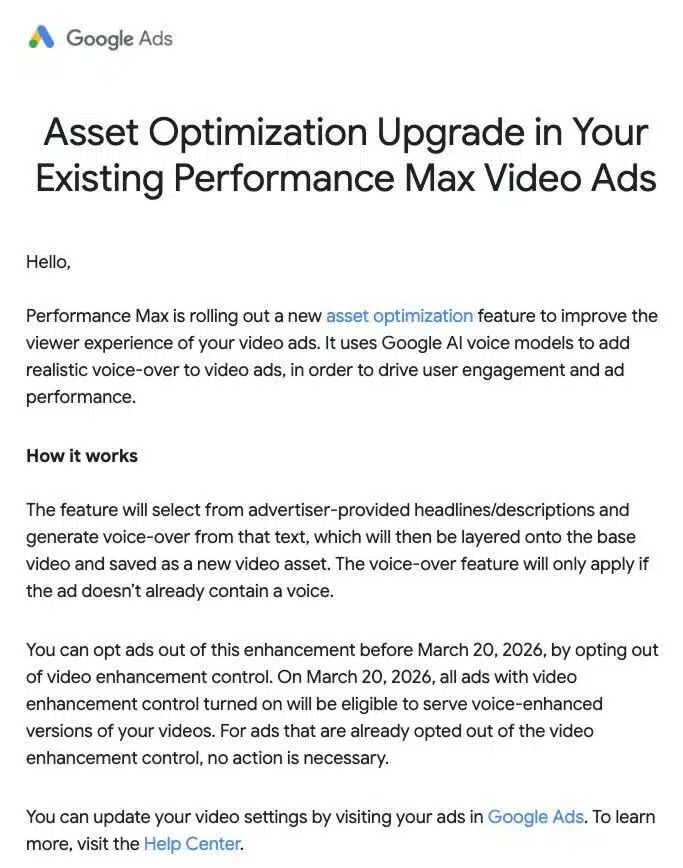
Source: Search Engine Land
When the voice-over is applied
AI voice-over is only applied when a video does not contain any spoken narration.
This typically includes:
- product videos with background music
- visual slideshow ads
- short promotional clips without narration
If the video already contains dialogue or a voice-over, the system leaves it unchanged.
Why Google is adding voice to ads
Video ads with spoken narration generally perform better than silent videos. They tend to capture more attention and improve brand recall.
The challenge has always been production. Creating a voice-over traditionally requires a script, a voice actor, recording, and post-production.
Automation removes that step. Advertisers write the ad text, and the system simply reads it.
Ad copy can suddenly become a script
One of the most interesting implications of this change is that ad copy can now become the script for the audio.
The AI does not write new text. It uses the headlines and descriptions that already exist in the campaign.
So if your ads contain generic phrases like:
“Shop now”
“Best deal”
“Limited offer”
The AI may literally read them out loud as the voice-over.
This means the quality of your copy now affects not only the visual part of the ad, but the audio experience as well.
When AI voice-over can be beneficial
For many companies, this feature can be a practical improvement. Especially when:
video ads are silent
- the marketing team doesn’t have resources to produce voice-overs
campaigns contain a large number of products or creatives
advertisers want to quickly test new video variations
In these situations, AI can improve the quality of ads without additional costs.
When it may make sense to turn it off
However, automatic voice-over will not suit every brand.
However, automatic voice-over will not suit every brand.
- a strong brand voice identity
- a dedicated voice actor or distinctive communication tone
- strict compliance rules in regulated industries
The automated voice may sound natural, but it is not tailored to a specific brand.
What advertisers should check
If you manage Performance Max campaigns, it’s worth doing a quick audit.
Focus especially on:
- the video enhancement control setting
- headlines and descriptions across asset groups
- asset groups that contain videos without voice-over
The key question to ask is simple: would this text make sense if someone read it out loud?
Advertising automation continues
AI voice-over is another step in Google’s ongoing automation of ad creative.
Performance Max can already:
- generate different video formats
- create shorter versions of longer videos
- adapt aspect ratios for mobile devices
- automatically test different ad variations
Adding voice is the next logical step.
For advertisers, this means one thing → creative is no longer static. It becomes a dynamic part of a system that can modify and optimize it in real time.
And that’s exactly why it will become increasingly important not only what video you create, but also what text you write in your ads.