 Skip to content


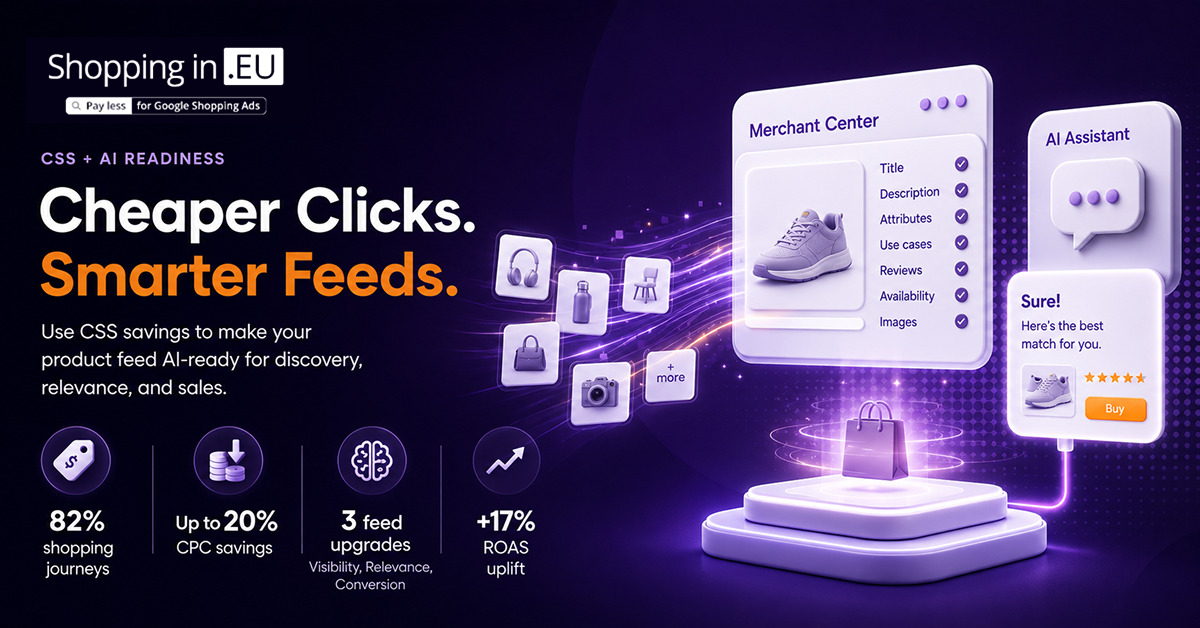
Today, up to 82% of shopping journeys where customers discover new brands or products involve Google or YouTube. However, the question is: When was the last time you optimized your product feed in the Merchant Center for someone other than a live human being?
While you are counting the euros saved thanks to an up to 20% discount on cost-per-click in auctions (which is a real advantage provided by a CSS partner based on the 2017 EU antitrust ruling), the rules of the e-commerce game have radically changed.
The Rise of Agentic Commerce
Customers today have fluid conversations with AI assistants and demand extremely specific solutions. If your Google Merchant Center (GMC) does not provide the algorithms with the right data, artificial intelligence will simply cross you off the list.
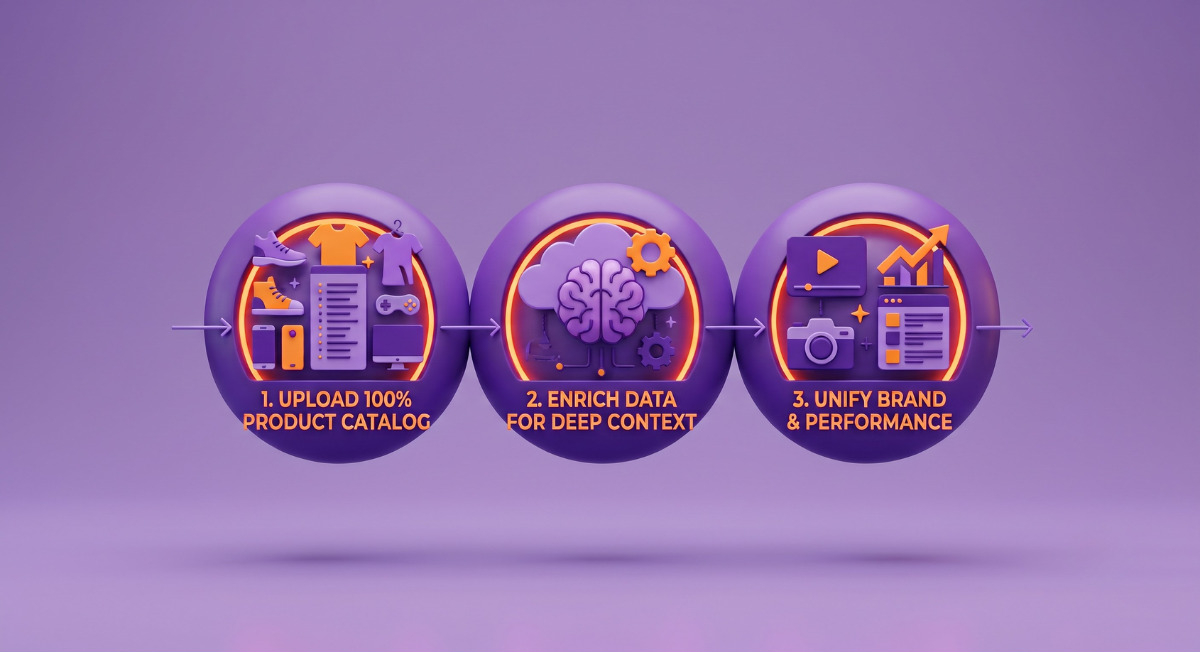
So, how do you turn the financial savings from the CSS program into perfect preparation for the AI era? Here are three areas you need to change in your online store.
1. Stop Cherry-Picking
An unwritten rule applies in classic performance marketing: we only send top products to shopping campaigns so we don’t lose money on expensive clicks. However, this approach immediately disqualifies you when it comes to artificial intelligence. AI often handles niche and very specific queries. If you hide these products from the feed, you miss out on conversions from the so-called long tail.
How to turn this to your advantage
Since you buy traffic with a 20% cost advantage over standard Google Shopping thanks to a certified CSS partner, the cost barrier falls. Use this margin and upload your entire product range to GMC.
Market Proof
The well-known retail chain Jysk found that their incomplete data feeds were hindering further growth. Therefore, they deployed an AI tool capable of loading complex data into the feeds in a structured way, including customer reviews. Search engines thus received exactly the data format they needed to start actively recommending their products.
2. Forget About Bare-bones Data
AI models require deep context
Do you have an EAN, a high-quality photo, a title, and a good price in your feed? A few years ago, that would have been enough. Today, it is woefully inadequate for AI.
In order for a modern AI assistant to explain to a customer why they should buy your product specifically (for example, why your shoes are suitable for running in the mud), it needs to understand the context. It needs to know the use cases and detailed product features.
The Solution
Invest the budget saved from CSS campaigns into centralizing data into a single hub (such as a PIM system). Then, connect large language models (LLMs), like Google Gemini, to this data, which will automatically generate rich descriptions for thousands of items.
Market Proof
The retailer Clas Ohlson integrated language models for mass auditing and copywriting across thousands of its product ads. The result was not only a dramatically shorter production time but also a demonstrably higher click-through rate (CTR).
3. Performance and Brand Must No Longer Live Separately
It is a huge mistake to think that the product feed in the Merchant Center and your video ads on YouTube are two different worlds. In the reality of agentic commerce, they are just two sources of information for the exact same artificial intelligence.
If AI has never seen your product in the context of a YouTube review or a visual campaign, it is unlikely to pull it from the feed and recommend it in a chat. Today, the unification of these worlds is enabled by the Universal Commerce Protocol (UCP) – a technological language that allows AI to search for a product and process its purchase directly within the conversation.
How to do it
Stop viewing brand formats as a luxury. Engage AI-powered ad formats that add visual context to your product feed.
Market Proof
Google’s analyses show that brands using modern video ad formats (such as Video view, Video reach, or Demand Gen) achieve on average a 17% higher return on ad spend (ROAS). A prime example is the retailer Ocado, where the combination of YouTube and Demand Gen campaigns brought direct conversions and interactions with new customers.
Summary for E-shops
Having clicks that are a fifth cheaper thanks to CSS is a fantastic stepping stone, but it cannot be your only goal. Use this freed-up capital to supply Google Merchant Center with a complete product catalog enriched with deep context. Because winning in e-commerce today no longer means just “being seen”. It means being 100% understood by artificial intelligence.