 Skip to content



Many e-commerce stores assume that after switching to CSS, their entire catalog will “automatically perform” better. The reality, however, is that CSS typically helps most significantly those products that already had demand or potential. The rest of the assortment often remains without visible change.
CSS improves CPC efficiency, not product demand
The core advantage of CSS lies in the fact that when you advertise through a CSS partner, Google does not deduct its margin from the cost per click (CPC) – your bid enters the auction at full value. This means your offer becomes more competitive in the auction without physically increasing the bid in your account.
However, CSS does not mean that people suddenly start searching more for a given product. CSS influences auction competition, not market demand.
If a product has no natural demand or is not relevant to search queries, a lower CPC alone is not enough to generate performance.
The auction still optimizes for performance
Even if CSS effectively lowers your CPC, Google’s algorithm is not required to show all products equally.
Google aukcia vyhodnocuje, ktoré produkty sú najrelevantnejšie pre konkrétny dopyt, aj keď bid je lacnejší, ak produkt nezodpovedá dotazu používateľa, nebude producovať impresie. To znamená, že ak máte stovky alebo tisíce produktov, len skupina, ktorá má reálny dopyt, dostane väčšiu šancu na zobrazenie.
Products without performance history are hard to “Kick-Start”
Products without sufficient history of clicks, conversions, or performance signals often do not win auctions – even with lower bids. When deciding what to show, Google’s algorithm prioritizes what has already proven to work.
This includes:
- new products
- long-tail assortment (low-demand products)
- products with feed issues
…CSS will not give them immediate or equal attention compared to bestsellers.
CSS does not influence feed quality or relevance
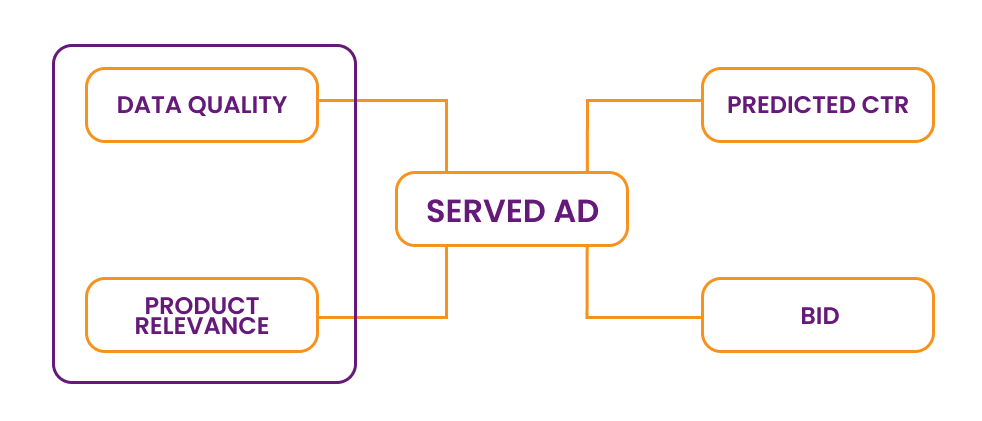
CSS does not make products relevant if they were not relevant before. In the auction, Google still evaluates:
- title and description quality
- relevance to the search query
- pricing compared to competitors
- ratings and reviews
If the feed is not optimized, CSS will not add relevance – it only improves bid competitiveness. These two effects together cannot compensate for a weak feed or low relevance.
Source: ProductHero
If a product lacks demand, CSS won’t “Reveal” it to users
The key explanation is simple: CSS reduces cost per click (CPC), but it does not increase user interest in a product.
What to do so CSS helps more products
If you want CSS benefits to extend beyond bestsellers, segment your catalog based on demand and value:
- Bestsellers – high-demand products
- High-potential products – competitive price, strong category
- Long-tail products – low-demand items
CSS is not a magic lever for the entire catalog. It is a financial auction advantage that can only be leveraged where a product already has potential.
Understanding why CSS does not work equally for all products allows you to better plan segmentation, allocate budgets efficiently, and set realistic expectations with clients or management.
Conclusion
A CSS partner can deliver lower CPCs and increase product competitiveness in Google Shopping campaigns. However, the entire catalog will not automatically perform better – the algorithm still determines which products are relevant to users. For maximum effect, CSS should be combined with feed optimization, proper product segmentation, and a clear bidding strategy.